Procedure explained
XERF treatment explained: how dual-frequency radiofrequency works
The short answer
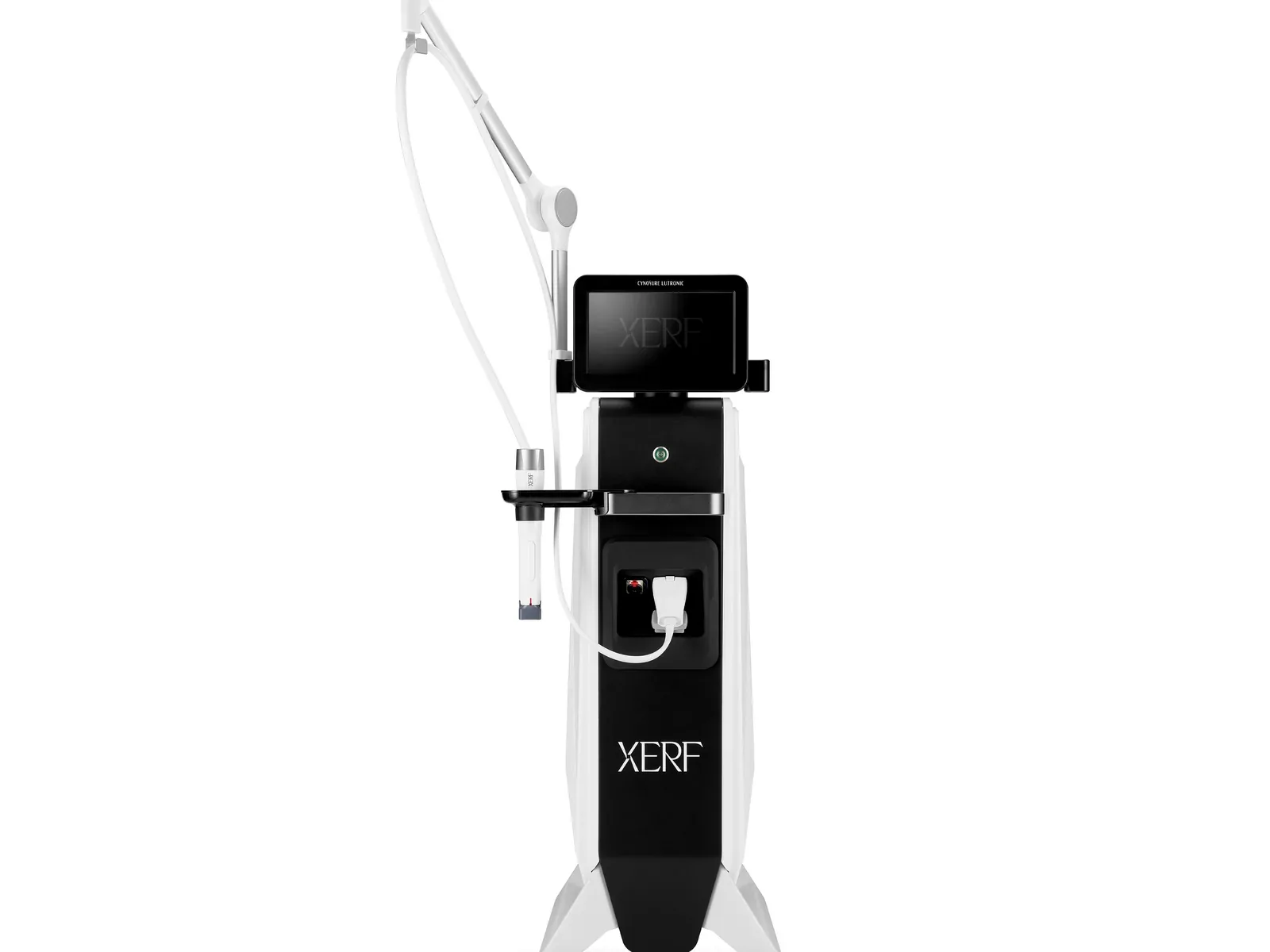
XERF is a clinician-operated monopolar radiofrequency procedure that passes electrical current through tissue to generate controlled heat. It can combine 6.78 MHz and 2 MHz energy in one pulse, aiming to heat both shallower and deeper tissue. That heating produces immediate collagen contraction and a slower wound-remodelling response, so any tightening develops gradually.
XERF belongs to a familiar category—monopolar radiofrequency—but adds a less familiar control: it can deliver two frequencies, 6.78 MHz and 2 MHz, within one treatment pulse. The useful question is not whether the second number sounds more advanced. It is what electrical current, frequency, tissue resistance and cooling do together.
What happens during a XERF treatment?
The clinician applies a coupling medium, places a return pad on the patient’s body and moves a single-use treatment tip across planned facial or body zones. The tip is the active electrode; the return pad is the neutral electrode. When a pulse fires, current travels from the tip through a broad volume of tissue and back to the pad.
That circuit is why the system is called monopolar. It is different from bipolar RF, where current travels between two nearby electrodes in the same handpiece, and from microneedle RF, where needles place electrodes inside the skin.
The FDA summary describes 12 compatible electrode tips and four treatment-tip sizes. It lists maximum outputs of 400 W at 6.78 MHz and 300 W at 2 MHz, with adjustable delivered energy. Those are system capabilities, not a recommended facial prescription. The clinician chooses the tip, mode, intensity, pulse pattern, overlap and number of passes for the anatomy being treated.
 active treatment tip
          ↓
   [ cooled epidermis ]
   [ dermis            ]  ← tissue resistance converts RF current to heat
   [ fibrous septa     ]
   [ subcutaneous layer]
          ↓
       return pad  → completes the circuit
How radiofrequency becomes heat
RF treatment does not heat skin by shining hot energy into it. An alternating electrical field causes charged particles in tissue to move. Tissue resists that movement, and electrical energy is converted into heat. This is often called resistive or Joule heating.
Three variables matter clinically:
- Energy delivery: how much electrical energy enters the treatment volume.
- Impedance: how strongly that tissue resists current at that moment.
- Time and cooling: how long deeper tissue accumulates heat while the surface is protected.
XERF measures impedance and adjusts delivery through what the manufacturer calls Accurate Impedance Feedback. Its handpiece also uses cryogen cooling at the surface. Cooling does not make deep heating disappear; it creates a thermal gradient so the treatment can heat below the epidermis while limiting surface injury and discomfort.
What do the two frequencies change?
Frequency describes how many times per second the electrical field alternates. XERF uses 6.78 million cycles per second and 2 million cycles per second.
The system is designed so 6.78 MHz supports a relatively shallower treatment distribution and 2 MHz contributes deeper, broader heating. It offers three depth settings and ten intensity levels. In a dual-frequency shot, the two are not separate layers drawn with surgical precision; they contribute to an overlapping three-dimensional thermal field whose shape also depends on tip geometry, impedance, contact, anatomy and pulse settings.
This distinction matters because clinic diagrams often portray RF as perfectly bounded horizontal bands. Real current density and temperature gradients are continuous. “Deep” is a relative treatment characteristic, not a promise that only one anatomical layer is heated.
Why controlled heating can tighten tissue
The intended biologic response has two phases.
Immediate thermal change. Sufficient heat alters hydrogen bonds within the collagen triple helix. Collagen bundles can shorten and thicken, producing some immediate tissue contraction. Transient swelling may also make an early result look stronger than the durable one.
Delayed remodelling. Controlled thermal injury initiates wound signalling. Fibroblasts and the extracellular matrix remodel over the following weeks and months, including new collagen formation. This slower phase is why a sensible review point is not the mirror immediately after treatment but standardised photographs taken later under the same lighting and expression.
XERF’s cosmetic language should nevertheless be kept proportional. The FDA-cleared indication is use in dermatologic and general surgical procedures for electrocoagulation and haemostasis. The manufacturer’s US page explicitly states that “skin tightening” describes tightening through soft-tissue coagulation. It is not an FDA approval for a non-surgical facelift.
What does the XERF evidence show?
There are three different evidence layers, and they should not be collapsed into one claim.
The mechanism is plausible and established for the RF category
Monopolar RF has been used in aesthetic medicine for more than two decades. Human studies of other monopolar devices report clinical and histologic changes after controlled dermal heating. That supports the category mechanism, but it does not establish that every device, setting or protocol performs equally.
XERF has animal histology
A 2024 letter reported findings from a porcine model treated with combined 6.78 + 2 MHz RF. Histology six hours after treatment showed shortened and thickened collagen bundles, thicker fibrous septa and changes in superficial and deep fascia. This is useful evidence that the device can create the intended thermal tissue response.
It cannot tell a patient how many millimetres their jawline will improve, how long a result will last or how often treatment should be repeated. It was an animal tissue study with an immediate endpoint, not a controlled cosmetic trial in people. A 2026 correction also disclosed that seven authors were employees of Cynosure Lutronic and that the manufacturer supplied the device. The original paper had incorrectly stated that the authors had no conflicts of interest. That does not invalidate the histology, but it materially lowers confidence in using the paper as independent validation.
Human XERF outcomes are preliminary
A 2026 retrospective study reviewed 16 adult women after a single XERF session, with follow-up immediately, at one month and at three months. Three-dimensional imaging and morphometric analysis suggested facial volume redistribution and progressive periorbital elevation; skin-analysis measures and patient-reported outcomes also improved. Reported adverse effects were mild and transient.
The limitations are substantial: a small sample, one private-clinic cohort, no randomisation, no sham treatment and no untreated control. Patients and assessors knew treatment had occurred. The study is a useful early signal, not a reliable estimate of average benefit or rare harms. Its own authors call for larger, prospective controlled studies.
What results should a patient expect?
The most defensible expectation is a modest, gradual improvement in laxity, texture or contour—not a transformation.
Some tightening may be visible immediately from collagen contraction and swelling. Remodelling may become more apparent over one to three months. The number of sessions is not universal; manufacturer imagery includes examples after one or two treatments, but before-and-after photographs are not a dosing standard.
Longevity has not been established by strong long-term XERF-specific trials. Age, baseline laxity, sun exposure, smoking, weight change, treatment energy and normal collagen turnover will all influence how a result evolves.
Pain, downtime and aftercare
XERF is marketed as a no-numbing treatment. Integrated cryogen cooling is meant to protect the epidermis and reduce the sensation of heat. That may shorten a visit compared with procedures that require topical anaesthetic, but “no numbing” should not be translated into “no sensation.” Patients can feel repeated warm or hot pulses, especially over thin tissue and bony areas.
Temporary redness, swelling, warmth or tenderness are plausible after RF. Follow the treating clinician’s instructions, use gentle skincare and sun protection, and avoid adding strong exfoliants or other energy procedures until the skin is settled. Blistering, persistent pain, weakness, asymmetry or a lasting sensory change warrants prompt clinical review.
Risks and who may not be suitable
Potential complications of energy-based RF include burns, blistering, altered pigment, contour irregularity, nerve irritation and unwanted change in subcutaneous volume. These are not predictions for every patient, but they are why operator training, anatomy and conservative parameter selection matter.
Published XERF research excluded people with implanted electronic devices such as pacemakers or defibrillators, active infection or inflammatory disease in the treatment area, pregnancy or breastfeeding, uncontrolled systemic disease and active malignancy in the treatment area. That research exclusion list is not a complete universal contraindication sheet; the clinician must use the current manufacturer instructions and an individual medical history.
Patients with a lean face or pre-existing volume loss should specifically discuss where deeper heating is planned. Current evidence does not provide a robust XERF-specific rate of unwanted facial fat loss, so absolute assurances in either direction are not evidence-based.
The current FDA recall
The FDA lists an open Class II recall for specified XERF EFFECTOR 60 models, serials and lots manufactured between 1 April and 20 August 2025. The stated reason is a manufacturing defect that could, on rare occasions, cause adverse events. The manufacturer instructed recipients to stop using affected units and return them.
This is not a recall of every XERF system or every treatment tip. It is still directly relevant to an informed-consent conversation. Before booking, ask the clinic to verify that its EFFECTOR 60 inventory is outside the affected lots or has completed the required correction. A clinic should be able to answer with a lot check, not reassurance alone.
Questions to ask before booking XERF
- Who will perform the treatment, and what training do they have with monopolar RF?
- Which depth mode, tip and energy strategy are planned for my anatomy—and why?
- How will you protect areas where I already have low facial volume?
- How many treatments are proposed, and what evidence supports that schedule?
- What side effects has this clinic seen, and how are burns or contour changes managed?
- Have all affected EFFECTOR 60 lots been removed or corrected under the FDA recall?
- Will photographs use fixed lighting, position and expression so the result can be judged honestly?
Bottom line
XERF is an interesting evolution of monopolar RF rather than an entirely new biologic mechanism. Its dual-frequency design gives the clinician more control over the distribution of tissue heating, while impedance feedback and surface cooling are intended to make energy delivery more consistent and tolerable.
The engineering case is credible. The XERF-specific clinical evidence is not yet mature. Animal histology shows that the device reaches and changes deeper connective structures; a very small uncontrolled human series reports encouraging three-month outcomes. Neither proves superiority over established RF systems or defines long-term benefit and risk. Choose the clinician and treatment plan at least as carefully as the device name.
Common questions
- What is a XERF treatment?
- XERF is a non-invasive, clinician-operated monopolar radiofrequency treatment. A handpiece places an active electrode against the skin, a return pad completes the circuit, and tissue resistance converts the electrical current into heat. The system can deliver 6.78 MHz and 2 MHz energy, separately or together, with selectable depth and intensity settings.
- How does XERF tighten skin?
- XERF creates controlled thermal coagulation in soft tissue. Heat can shorten existing collagen structures immediately and initiate a repair response involving collagen remodelling over subsequent weeks and months. The visible effect should be described as gradual, non-surgical tightening—not as lifting equivalent to a facelift.
- Is XERF painful and does it require downtime?
- The manufacturer markets treatment without numbing and uses integrated cryogen cooling to protect the surface and improve comfort. Patients may still feel repeated pulses of deep heat, and tolerance varies with settings and anatomy. Temporary redness, swelling or tenderness can occur even when normal activities resume quickly.
- When do XERF results appear and how long do they last?
- Some change may look immediate because heated collagen contracts and temporary swelling alters contours. Biologic remodelling takes longer, so assessment is more meaningful after roughly one to three months. Reliable duration and maintenance intervals have not yet been established by large, controlled, long-term XERF trials.
- Can XERF cause facial fat loss?
- Deep radiofrequency can reach tissue around the subcutaneous layer, so treatment planning matters, especially in a lean face. Published XERF evidence does not yet quantify the risk of unwanted volume loss. Ask the treating clinician how depth, energy, passes and facial anatomy will be managed, and avoid promises that the risk is impossible.
- Is XERF FDA approved?
- XERF received FDA 510(k) clearance in August 2025 after being found substantially equivalent to legally marketed devices. Its stated indication is electrocoagulation and haemostasis in dermatologic and general surgical procedures. A 510(k) clearance is not premarket approval and does not independently prove every advertised cosmetic outcome.
- Is there a recall for XERF?
- Yes. The FDA lists an open Class II recall covering specified XERF EFFECTOR 60 models and lots manufactured from April through August 2025. The manufacturer instructed recipients to stop using and return affected units. Before treatment, ask the clinic to confirm that its tip lot is unaffected or has been corrected.
Sources
- FDA 510(k) summary for XERF, K251327 — U.S. Food and Drug Administration Accessed 21 September 2026.
- FDA Class II recall — XERF EFFECTOR 60 — U.S. Food and Drug Administration Accessed 21 September 2026.
- XERF structural skin tightening — system and technical features — Cynosure Lutronic Accessed 21 September 2026.
- Hong J, et al. Dual-frequency non-invasive monopolar radiofrequency: histological evidence — Skin Research and Technology, 2024 Accessed 21 September 2026.
- Correction to the XERF histology study conflict-of-interest statement — Skin Research and Technology, 2026 Accessed 21 September 2026.
- Objective and subjective retrospective evaluation of XERF — Peer-reviewed retrospective study, 2026 Accessed 21 September 2026.
- Suh DH, et al. Monopolar radiofrequency for facial laxity: histometric analysis — Journal of Cosmetic Dermatology, 2020 Accessed 21 September 2026.
This is general information about cosmetic formulation, not medical advice. It does not replace a consultation for your own skin.